When Did Catering Become About More Than the Food?

Bride and Groom First Dance.

My niece got married recently, and I have not stopped thinking about it.

She was sung down the aisle. Members of her own family were in the band, and they played Amazing Grace as she walked, and carried on with song after song that lifted the whole room. The speeches were properly funny, and there were more of them than I have ever heard at a wedding. The bride gave one. Her chief bridesmaid gave one. It seemed as though anybody with something to say simply stood up and said it.

The first dance was not really a first dance. Rather than something romantic to be watched politely, it was staged, theatrical and deliberately funny, with the whole room in screams of laughter and cheering them on. Half of us picked the routine up as we went. Ridiculous happiness is the only way I can describe it.

I left feeling something I have not felt at a wedding before. Not just that it had been lovely, although it was. Something closer to elation — enormously grateful for the people around me, and aware that I had been part of the day rather than a guest at it. Everyone there had been let into it.

The venue was beautiful and the food was good. I am not certain either was the reason anybody felt that way.
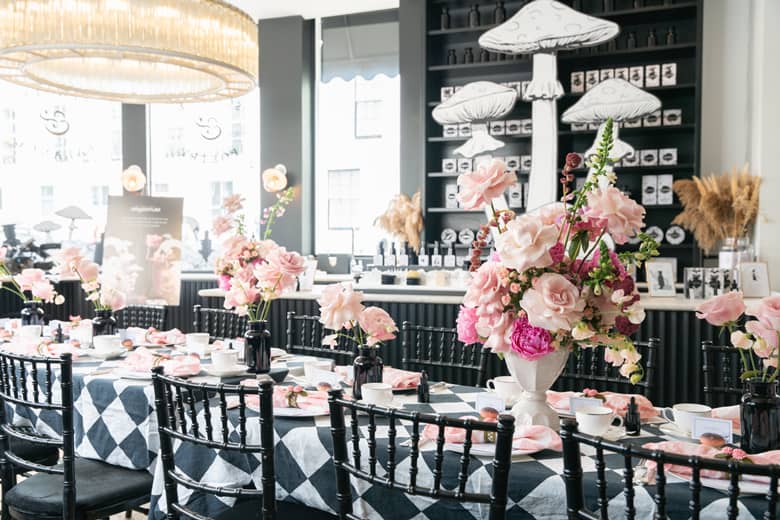
Magical tea party table settings.

How our own events have changed

It made me think about how much our own work has shifted.

Ten years ago we thought first about the food. We still do, obviously — we are caterers. But now we are thinking just as much about what people hear when they walk in, what the room smells like, what the staff are wearing, what guests are actually going to do, and most importantly of all, how we are going to make them feel part of it.

That is a different job from the one we used to have. The food is still at the centre of it. It is simply no longer the whole of it.

Man making a cocktail at a bar.

From spectacle to participation

For a long time, an event was something you attended. You arrived, you admired a beautiful room, you were fed, you watched other people do things, and you went home.

Increasingly, people want more than that, and you can see it everywhere. Receiving lines replaced by cocktails and live music. Tiered cakes replaced by stations people gather round. Mixology, live illustrators, lawn games, singing waiters.

The shift is from spectacle to participation. From a room designed to be admired, to a room designed to be joined.

Interestingly, research into group bonding backs this up: singing and moving together are particularly powerful ways of bringing people closer. Which is a fairly exact description of my niece's wedding. Though anyone who was in that room already knew.

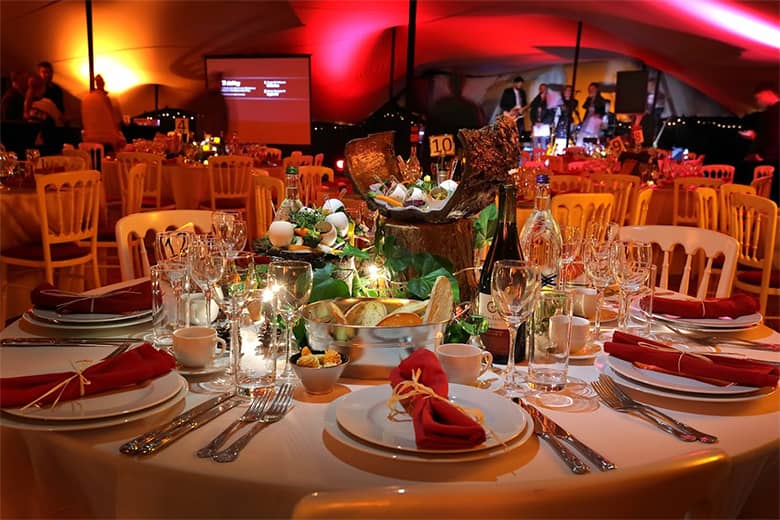
Ferblanc Ball event tables with band in the background.

The whole room, not just the plate

The other half of it is sensory, and food has more power here than it is usually given credit for.

Work at Oxford has shown that changing only the sound of a crisp alters how fresh people judge it to be. Taste, it turns out, happens well beyond the mouth.

So we think about what a room smells of, how it is lit and what is playing, alongside what is on the table. A space that smells of woodsmoke or citrus has told everybody something before a word is spoken.

That includes our teams, which is easy to overlook. We dress our staff to suit the look and feel of the room rather than putting them in a standard uniform, because a stiff black-and-white brigade sets a tone whether you meant it to or not. Warm, approachable people who are visibly enjoying themselves change a room faster than any centrepiece.

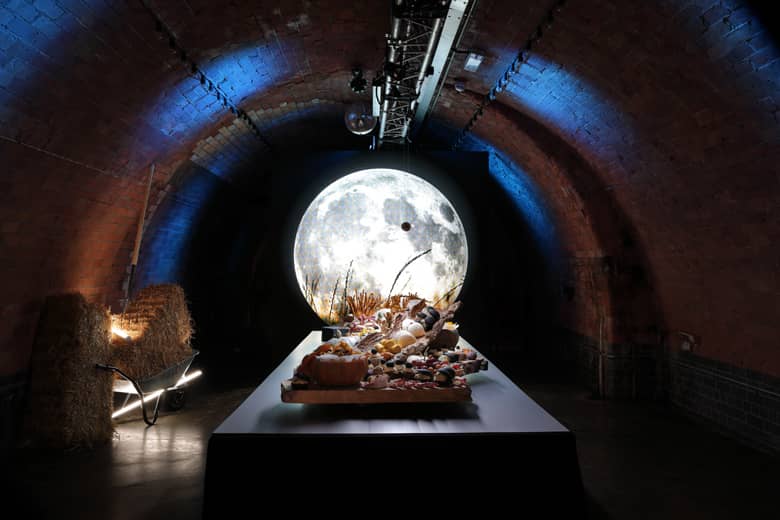
Harvest Moon Bounty Board
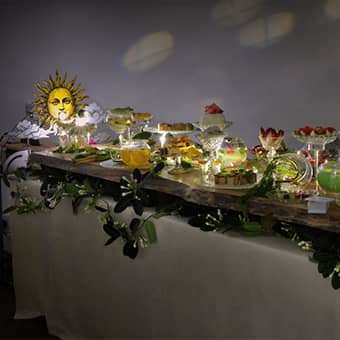
Aestival Spread of Food by Max Robinson
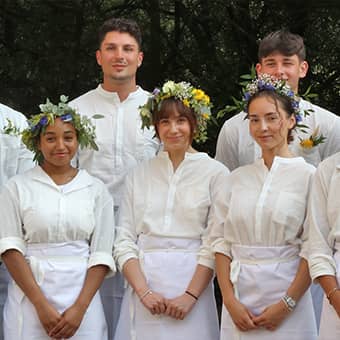
PenniBlack Waiting Staff

Three tables

Our supper clubs are where we push this hardest. Each is built from a single idea, and everything follows from it — the table, the food, the light, the sound and the people serving it. Guests sit around one long central table and eat from it, rather than being served individual plates in a room that happens to be decorated.

Harvest Moon turned the table into one enormous wooden board, loaded end to end with pumpkins and everything else the season had to give. A giant moon was projected across it and onto the wall behind, lighting the whole thing in an otherwise dark room. The music followed the turn of the season from warmth into cold, eerie and moonlit, with owls and wolves woven through it. Our team wore their hair in loose plaits and looked like farmers as styled by a fashion shoot.

Northern Lights made the table a landscape. Winding black boards ran down its length like rivers, with great rocks set among them and the food built onto the rocks themselves. The lights were projected across one end, moving over the table as people ate, and the team wore beanie hats and looked, deliberately, like extremely good-looking fishermen.

Aestival took the opposite end of the year. A sun lit through a crystal above the table threw rays that travelled slowly along its length, catching on glass — everything on that table was glass — with giant jellies wobbling among it. Whimsical, faintly trippy, and set to fairytale, nursery-rhyme music that lifted the room without anyone noticing why. Our team wore white, blue jeans, crisp aprons and little summer garden hairpieces, men and women alike.

None of those is really about the styling, which is the point. Each gives guests something to do together. They reach across a shared table rather than waiting for a plate. They ask what something is, the chef comes out and tells them, and every element has a story attached.

A table that invites a question is doing far more work than a table that only looks beautiful.

Creative Canapé Making Workshop

Putting people to work

The clearest version of this is handing guests a job.

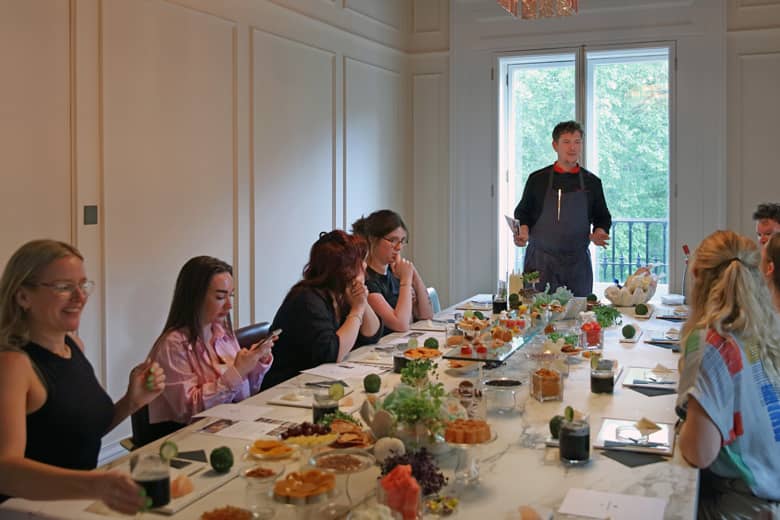
We ran a canapé making workshop recently with one of our chefs. The table was styled properly, there was a drink in everyone's hand on arrival, and each round was paired with a wine. Then people made canapés, and somebody won.

That last part mattered more than any of us expected. There was cheering. There was clapping. People celebrated each other's efforts with genuine enthusiasm, round after round, and by the end the room was completely different from the one that had walked in.

The food was good. The competition was what people talked about afterwards.

Guests laugh and point during a lively game around a candlelit dinner table while a facilitator guides the conversation.

Somebody has to own the atmosphere

Here is something I learned hosting my own dinner party.

I wanted it to be genuinely fun, and I realised I could not do that and host at the same time. Running the food, watching the room and keeping the energy up are three jobs, and doing all three means doing none of them well.

So I brought in people who are good with people, whose entire job was to get the table talking and run games. One was a version of The Traitors — a couple of people at the table secretly working against everyone else, and the rest trying to work out who. Accusations, defences, laughter, the whole table in it.

It was the best dinner party I have thrown, and I did almost none of the entertaining myself.

Atmosphere is not something that happens if the food is nice enough. It is a job, and somebody should own it.

Where to start checklist.

Where to start

You do not need to reinvent the whole occasion.

  1. Give people something to do early, rather than waiting for the drinks to wear the awkwardness off
  2. Put the food in the middle. A shared table asks people to reach, pass and talk in a way individual plates never will
  3. Build in one moment where everyone does the same thing at once — a toast, a song, a game
  4. Think about smell and sound, not only how it looks. They cost very little and do more than people expect
  5. Let the staff be human. How they dress and how they are sets the tone before anything else
  6. Give somebody the job of the atmosphere, and make sure it is not the host

People remember how an occasion made them feel, and they feel most when they were part of it rather than watching it.

That is what I took away from my niece's wedding, and it is why our idea of catering looks so different from the one we started with.

Planning something and want it to be more than a lovely room and good food?

That is the part we most enjoy. Tell us what you are thinking and we will build something around it.

Get In Touch