Woman planning an event in a diary.

How to Plan an Event to a Budget, and Actually Stay On It

Most people who go over budget didn’t overspend on the day. They overspent three weeks earlier, when they accepted a quote that wasn’t really a quote, or chose a supplier on price alone.

The bill afterwards is where that catches up with you. And there’s nothing worse than working carefully to a number all the way through, particularly on behalf of a client, then finding several hundred pounds of charges you had no way of anticipating.

Almost all of it is avoidable.
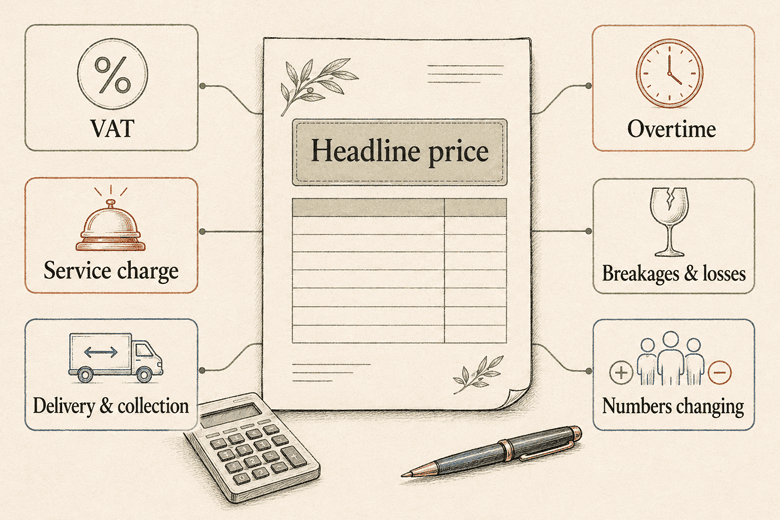
Illustrated event quote showing costs to check beyond the headline price, including VAT, service charge, delivery, overtime, breakages and changing guest numbers.

Start with the quote, not the price

A number on its own tells you very little. What you need is a fully itemised quote, in writing, making clear:

  • Whether the figure is inclusive or exclusive of VAT
  • Whether a service charge is included and, if not, what it will be
  • Travel, delivery and collection charges
  • Overtime rates, and when they start
  • What happens if numbers change, and when they must be confirmed
  • Charges for breakages and losses, per item

Extras like these can add twenty to forty per cent to a headline per-head price. If two quotes look very different, it is often because one has included what the other has left for later.

Ask directly. A supplier reluctant to itemise is telling you something useful.

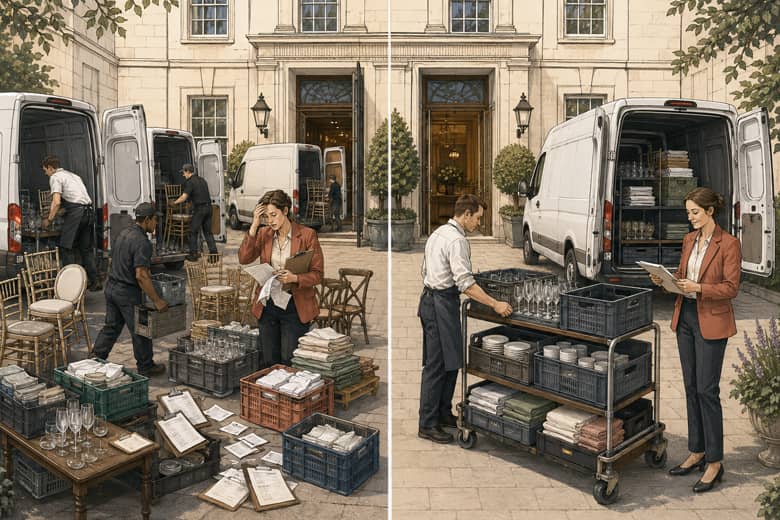
Split illustration comparing several cluttered catering deliveries and duplicated paperwork with one organised supplier delivery at an event venue.

The cheapest supplier isn’t always the cheapest outcome

Price matters, obviously, but so does whether a supplier arrives when they say they will, whether what arrives has been checked and is good quality, and whether you can have a sensible conversation if something goes wrong.

Read reviews properly, particularly the ones where something went wrong and how it was handled. Go on recommendation wherever you can. Ask how losses and breakages are tracked and what evidence you’ll be given. And ask what happens if a delivery is late.

Where possible, use one supplier for as much as you can. Three hire companies mean three delivery charges, three collections, three vehicles and three sets of paperwork.

One company supplying furniture, crockery, glassware and linen will often work out cheaper than choosing the lowest individual price for each. It also gives you one point of contact on the day, which matters more than people expect.

Delivry driver loading a van.

Be flexible on delivery — and get it there early

This is a saving almost nobody knows about.

Ask for a timed delivery slot and you’ll pay considerably more because you’re asking a supplier to build their day around you. If you can accept delivery the day before and collection the day after, they can often fit you into an existing run. Same equipment, same company, a fraction of the delivery cost.

Getting everything there early also buys you the thing you most need: time.

You can set up calmly rather than waiting for a van. You can check and photograph everything against the delivery note before anyone touches it. And if something is missing, you know it was missing from the start.

Late deliveries cost real money. A team standing around waiting is a team you’re paying for nothing, and the hour lost at the beginning often comes back at the end at overtime rates.

People carrying boxes and plants up stairs.

Tell suppliers about access before they quote

Walk the route on your venue visit looking at it as somebody carrying crates, not as a guest arriving. Tell suppliers, in writing, about:

  • Stairs and how many
  • Lifts, including whether they’re big enough
  • Where vehicles can stop and for how long
  • Double yellows, red routes and loading restrictions
  • Congestion and ULEZ charges
  • Long carries from vehicle to room
  • Restrictions on delivery times

None of this will make a good supplier refuse the job. It simply means the quote is right first time rather than the extra charges appearing afterwards.

And get a mobile number for the person actually driving — not just the office and certainly not somebody who goes home at five. Most delivery problems are manageable if you know about them early. They become disasters when you discover them because the van hasn’t arrived.

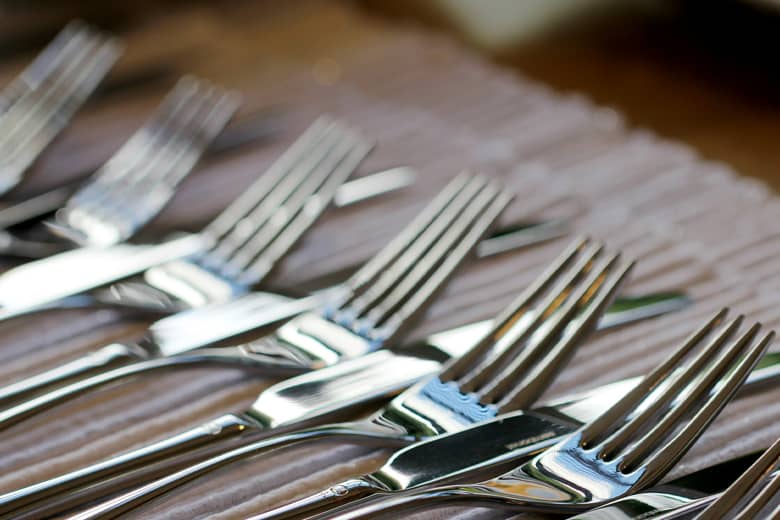
Stainless steel forks and knives on brown wooden table

Count everything in — and everything back out

Hire losses are where budgets quietly haemorrhage, and they are largely preventable.

Count everything when it arrives, photograph it and note anything broken or missing immediately. Then count it all again before it leaves.

Glasses are relatively easy because they arrive in boxes. Cutlery is where it goes wrong. Forks disappear into napkins, bins and the wrong crates, and nobody notices until an invoice arrives charging five pounds each.

Make counting somebody’s actual job, rather than something everyone assumes somebody else is doing.

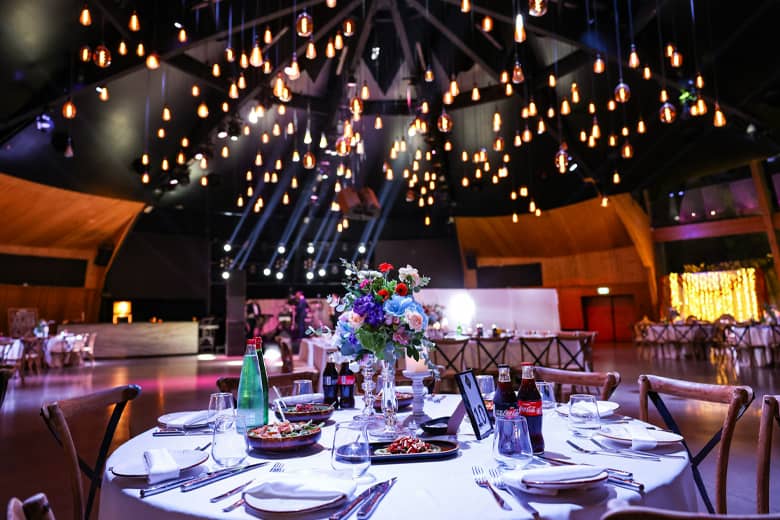
Venue setup for an event with lighting, tableware, and entertainment.

Check what the venue actually gives you

Before deciding anything else, establish what is already there.

  • Is there a kitchen?
  • Are there tables and chairs?
  • Is there crockery, cutlery, glassware and linen?

A seated dinner in an empty venue can mean hiring an oven, portable kitchen, tables, chairs and an entire set of tableware before you have bought a single ingredient.

Which is why the next decision matters so much.

British Bloom Bowls - Salted chocolate ganache with sea salt crumble.

Choose the service style before the menu

This is one of the biggest levers you can pull on an event budget, because it affects both hire and staffing.

A formal plated meal needs plates dressed in the kitchen and carried individually to every guest, course after course. That means more chefs, more waiting staff, tables, chairs and a full cover of tableware.

Family-style service, with generous bowls and sharing dishes down the middle of the table, needs fewer staff and less tableware. It is also warmer, more sociable and often nicer to sit at.

Canapés and bowl food at a standing event remove much of it altogether. No seating plan, no full covers, no dining chairs and considerably fewer staff

Choose your service style before you fall in love with a menu. It will tell you very quickly what is achievable within your budget.

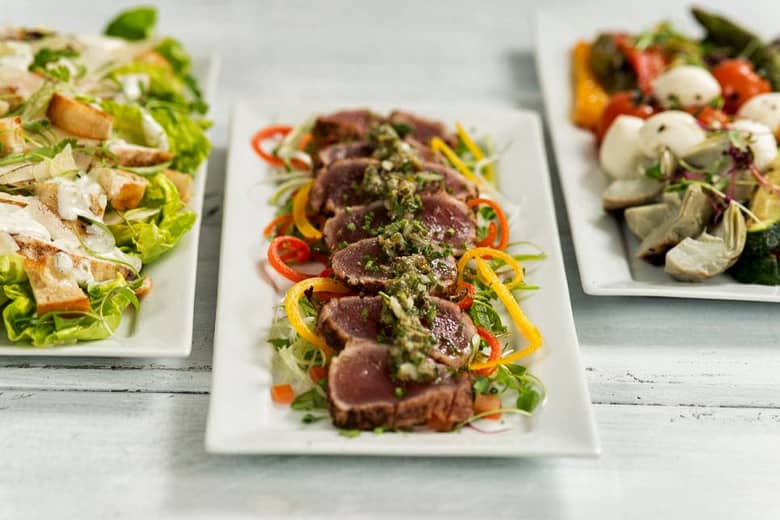
Cold buffet platters by PenniBlack.

Let the menu do the saving

Working to a budget doesn’t mean cheap food. It means understanding where the cost actually sits in a dish — and very often that is in labour, not ingredients.

Use cheaper cuts well. Slow-cooked and marinated cuts can be more interesting than expensive ones at a fraction of the price. The same applies to less fashionable fish.

Buy seasonal and local. Produce at its peak is cheaper, better and needs less doing to it.

Let vegetables do some real work. They don’t always need to sit at the edge of the plate as a garnish.

Fewer moves on the plate. Every additional component is another pair of hands and another minute. Three things done beautifully can taste as good as seven and cost considerably less.

Think about what actually needs heat. A cold starter or dessert means less going through the oven and fewer chefs needed on the night. The more that can be prepared ahead, the easier the event is to deliver — and none of it needs to be any less lovely.

Offer fewer choices. One or two mains rather than a huge selection reduces preparation, stock and waste together.

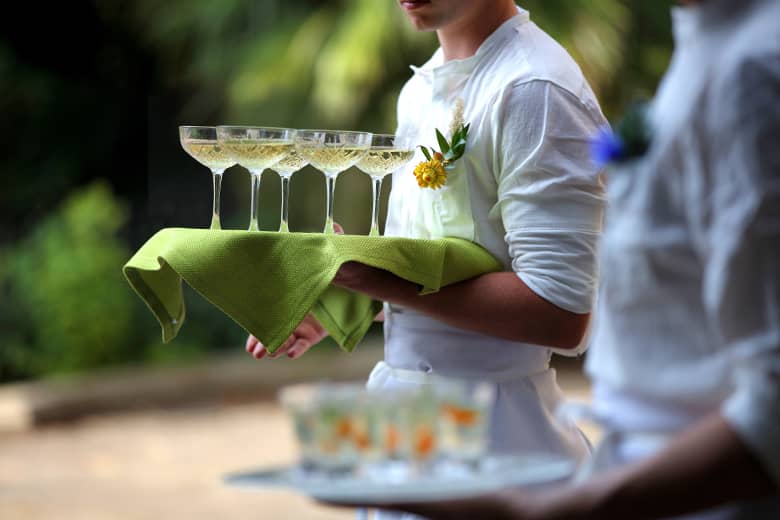
PenniBlack staff serving drinks.

Don’t economise on staff

Of everything here, this is where cutting costs reliably costs more.

Slow service means staff stay longer and you pay for those hours. Inexperienced teams take longer to set up, serve and clear, miss things, and the things they miss often appear on an invoice later.

Experienced supervisors know how to run a room. The event stays on time, setting up and clearing down happen faster, equipment gets counted and problems are solved on the night rather than discovered afterwards.

And then there is the part that appears on no budget at all. A team who are warm, engaged and genuinely happy to be there change how the whole evening feels, and guests remember it. That is worth every penny, and it isn’t something you can buy cheaply.

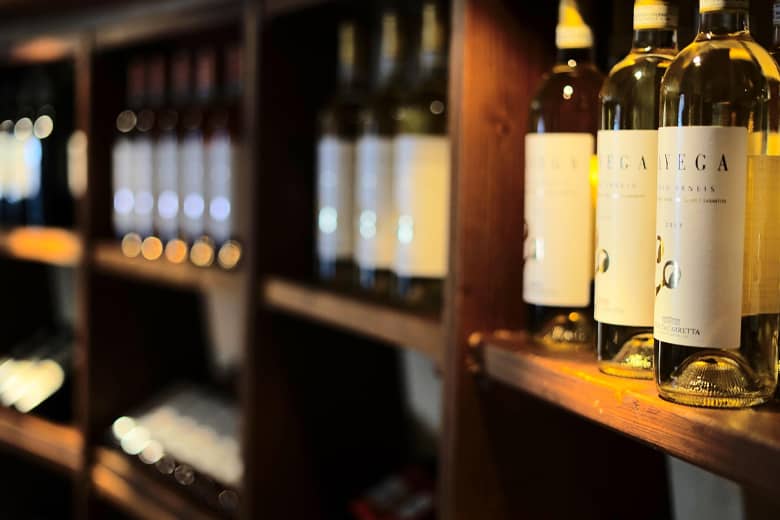
Wine rack with a selection of wines on display.

Be clever with drinks

Take drinks on sale or return wherever possible, so you don’t pay for what nobody drinks.

Buy ahead when wine merchants have offers rather than leaving everything until the last minute.

Always check corkage before committing to bringing your own drinks. A venue charging £8–£20 a bottle can wipe out the saving entirely.

And don’t assume choice equals generosity. One good white, one good red, something sparkling and a proper non-alcoholic option is often plenty.

A signature drink on arrival can also feel much more special than simply opening a full bar.

Bark platters filled with canapés ready for service.

Style it yourself — and enjoy it

If your budget gives you white plates and plain glassware, that is a starting point, not a problem.

Reclaimed wood, sanded and varnished, makes beautiful boards for canapés and grazing.

Flowers from the market divided between little bud vases can look far more considered than one expensive arrangement. Someone’s garden, with permission and in season, can be better still.

And height and level can transform a table more than expensive china. Boxes, boards, stands and a bit of thought go a long way.

Pinterest and Instagram are genuinely useful. Find people whose work you admire, work out what they are doing, and see what you can make yourself.

Some of the loveliest tables we have laid cost very little. What they had was attention.

Piggy Bank for contingency fund.

Build in a contingency — and protect it

Put aside ten to fifteen per cent of the budget and treat it as untouchable until the week of the event.

It isn’t spare money. It is what stands between you and an awkward conversation when numbers change, the weather turns or something arrives broken.

If you don’t need it, you have come in under budget. Which is a considerably nicer feeling than the alternative.

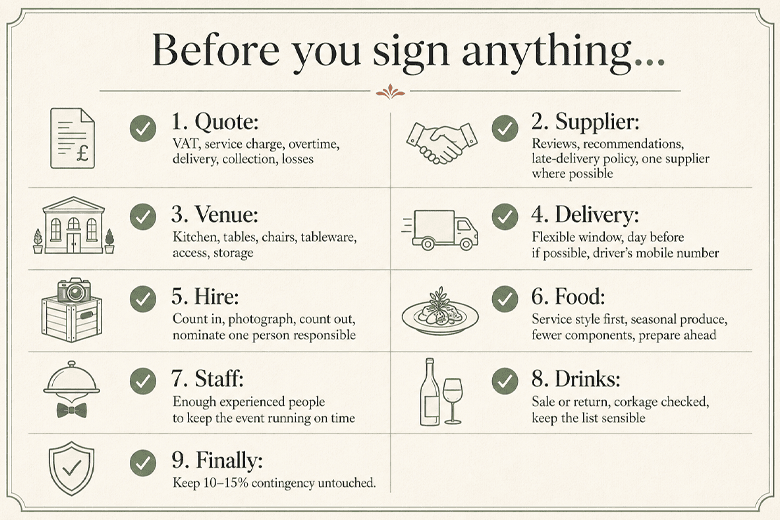
Before you sign checklist.

Before you sign anything…

  • Quote: VAT · service charge · overtime · delivery · collection · losses
  • Supplier: reviews · recommendations · late-delivery policy · one supplier where possible
  • Venue: kitchen · tables · chairs · tableware · access · storage
  • Delivery: flexible window · day before if possible · driver’s mobile number
  • Hire: count in · photograph · count out · nominate one person responsible
  • Food: service style first · seasonal produce · fewer components · prepare ahead
  • Staff: enough experienced people to keep the event running on time
  • Drinks: sale or return · corkage checked · keep the list sensible
  • Finally: keep 10–15% contingency untouched.

Planning something and want to talk it through?

We’re always happy to look at a budget honestly and tell you what is realistic — including where you can spend less without anyone noticing.

Get In Touch